)
History
- A 38 week male neonate was delivered by LSCS for fetal bradycardia. He was
found flaccid, cyanotic, apnoeic and required intubation at 1 min of life. A/N
history showed intrauterine growth retardation, paucity of fetal movement and
polyhydramnios. The baby was kept intubated from day 0 to day 23. After extubation,
the baby was noticed to have poor breathing effort requiring nasal SIMV, nasal
CPAP and subsequently BiPAP. He was noted to have poor feeding. Family history
was unremarkable with no neurological and neuromuscular diseases. Multiple members
in the maternal family are affected by cataract.
| |
| Pedigree |
Examination of the neurological system is shown in the video clip.
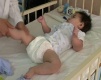  |
| Video - baby |
Answer to Q1
Hypotonia/Floppy Baby Syndrome
|
Click photos to view
|
Signs
|
) |
Frog likeposture
|
) |
Head lag on arm traction
|
) |
Inverted U sign in ventral suspension
test
|
) |
Slip-through-shoulder sign in vertical
suspension test
|
) |
Scarf sign. Note:elbow crossed mid-line
|
) |
Heel-to-ear sign
|
Q2
-What do you observe on the face of this patient?Compare to the photo of
another patient with the same disease (found in textbook).
) |
) |
| Photo1 | Photo2 |
Answer to Q2
Myopathic face
Q3
- What
additional feature do you observe in this photo?
Answer to Q3
Undescended testes
Q4
- What is the general approach to hypotonia?
Answer to Q4
Please click to open: Approach to Floppy Infant
Further reading:
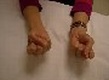
Mother asked to open and clench hands repetitively as quickly as possible
 |
) |
) |
| Video - mother (She was asked to open and clench hands repetitively as quickly as possible) |
Mother asked to smile | Mother asked to blow her cheek |
Part of the investigation results of the child:-
CPK: normal
Karyotype 46 XY
) |
| Muscle biopsy report |
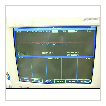
EMG of patient and his mother
 |
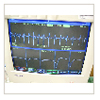 |
| EMG of Patient | EMG of Mother |
Q5
-What is the EMG finding for mother and baby?
Answer to Q5
Myotonic discharges
Answer to Q6
Myotonic dystrophy
Comment
The mother also has mild myopathic face with temporal and masseteric wasting. She shows delayed relaxation after clenching, suspicious of myotonia. EMG has been arranged for the mother for confirmation. A normal karyotype excludes syndromic disorder due to chromosomal aberrations. CPK is markedly raised in chronic myopathies such as Duchene muscular dystrophy, dermatomyositis and polymyositis. It is normal to mildly raised in congenital myopathies and myotonic dystrophy.
EMG has not been done in this case but could be helpful. Typical myopathic pattern and denervation pattern should point to different anatomical localization of pathology. Typical pattern may be observed in specific diseases such as myotonia, i.e. trains of spontaneous discharge from single fibre or group of fibres upon stimulation by needle probe, also known as 'dive bomber' pattern when connected to speaker.
Muscle biopsy has been performed in this case. In the workup of floppy infant syndrome, glycogen and lipid storage disease may be demonstrated by presence of storage within muscle fibres. Mitochondrial DNA defect is characterized by ragged red fibres. Several congenital myopathies may show characteristic features such as centrally located nucleus or aggregation of material/enzyme, while some rare forms require electron microscopy or special enzyme staining. Type I fibre hypotrophy is non-specific and can be secondary to a number of causes. (Dunn, D.W. 1987, eMedicine accessed 15/6/2007).
In this patient, genetic test for myotonic dystrophy has been performed and the report shows: -
) |
) |
| Genetic report | Southern blot result for our patient |
Genetic mechanism of myotonia dystrophica (see
separate word file)
Q7
- The mother also provided a family photo. Who do you think is affected?
) |
| Family |
Answer to Q7
Mother is the 1st one at the right side. The maternal uncle (2nd one to the left) resembles the mother and is suspected to be affected. Actually all maternal family member, especially those with cataract, need detailed evaluation for myotonic dystrophy. Genetic counseling should be provided if necessary.
Another clinical quiz for hypotonia is available,
click here to attempt
-------------------------------------------------------------------------------------------------------
Reference
Suggested Reading:
For comments and questions, please send email to: Dr. Brian Chung (bhychung@hkucc.hku.hk)
Dr. Brian Chung, Dr WL Yang, and Wong Wui Bun and Zhu Yi Dan (2007 SSM student)
Acknowledgement: Special Thanks to
Dr P Lee and
2007 SSM "Clinical Genetic" Teaching Group
Dr Sophelia Chan for the EMG clips
Prof V Wong, Dr CW Fung and Neurology Team
Department of
Paediatrics & Adolescent Medicine;
The University of Hong Kong
)